Across India’s farmlands, women are the silent force behind every harvest. They contribute nearly 75% of all agricultural labour, according to the Ministry of Agriculture & Farmers Welfare (2024). Yet, for decades, their work has been defined by physical strain and long hours. Manual tasks like weeding, sowing, and reaping demand immense effort, leaving little room for rest or personal growth.
Despite their contribution, women farmers often lack access to modern agricultural machinery. Heavy agricultural equipment has traditionally been designed for men. The result? Women continue to depend on outdated, manual tools that drain energy and time. But the landscape is changing, and mechanised farming is becoming the gender equaliser rural India needs.
Mechanisation doesn’t just improve productivity. It transforms how women engage with agriculture, turning them from labourers into decision-makers, entrepreneurs, and innovators.
When small-scale modern agricultural machinery enters a woman farmer’s field, the transformation is visible. Tasks that once required hours of bending, pulling, and carrying now take minutes. Mechanised farming reduces physical burden while enhancing precision and efficiency.
Women using compact farm machines report saving up to 60% of their time compared to manual work, as reported by ICAR, 2023. This efficiency means more control over their schedules and income. With lighter, ergonomic agricultural equipment, women can manage operations independently without relying on additional labour.
Absolutely. Machines designed with adjustable handles, low vibration, and balanced weight distribution are game-changers. They make modern agricultural machinery not just user-friendly but empowering, ensuring women farmers operate confidently and safely.
Research by the Central Institute of Agricultural Engineering (CIAE) shows that using a power weeder cuts labour effort by almost 70%. A task that takes eight hours manually can be done in less than three with mechanised assistance. This efficiency translates into higher output and less fatigue.
At Krishitek, we understand that empowerment begins with accessibility. Our range of women-friendly agriculture machines helps small and marginal women farmers save time, increase productivity, and reduce dependency on hired labour.
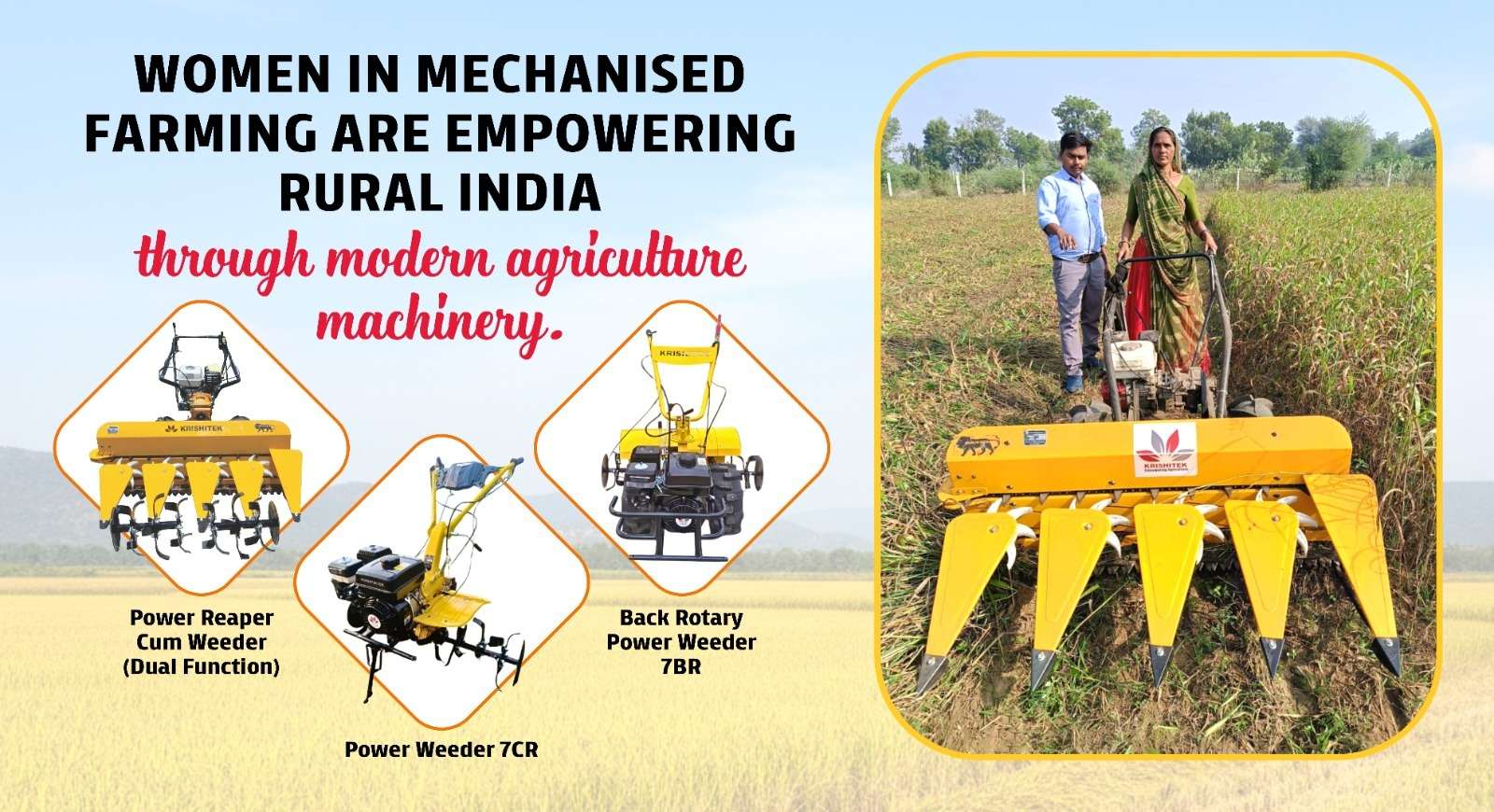
The Back Rotary Power Weeder 7BR combines control with comfort. Its rotary blades ensure deep and even soil aeration, improving moisture retention and crop yield. Studies from ICAR, 2022, show that well-aerated soil can increase yield by 10–15%. The ergonomic design minimises vibration, letting women operate comfortably. This balance between power and ease makes it one of the best examples of modern agricultural machinery tailored for women.
Krishitek’s Power Reaper Cum Weeder performs dual functions: reaping and weeding, supported by Left-Hand Side (LHS) and Right-Hand Side (RHS) clutch systems. For women farmers managing seasonal crops, this dual-purpose machine saves money and effort. Transitioning from weeding to harvesting becomes seamless, eliminating the need for multiple machines or extra manpower.
A proud farmer, Ms Rinaben Solanki:
A trailblazer from Upleta, Rajkot, Gujarat, epitomises the spirit of resilience and determination. With her Krishitek Power Weeder in hand, she cultivates five acres of land, nurturing dragon fruits, wheat, soybeans, and more. For Rinaben, farming is not just a livelihood; it’s a passion that brings her immense joy and fulfilment. Her dedication has not gone unnoticed, inspiring fellow women farmers and setting a shining example of what is possible with grit and determination.
A proud farmer, Mrs Premilaben:
Hailing from Kadi, Gandhinagar, is another shining beacon of empowerment. Despite her limited formal education, her passion for farming and eagerness to learn knew no bounds. With the guidance of Krishitek’s service engineers, she mastered the operation of the Power Reaper, effortlessly harvesting her paddy and wheat fields. Premilaben’s journey is a testament to the transformative power of education and the unwavering spirit of women in agriculture.
Stories like these highlight the measurable benefits of mechanised farming – more productivity, less fatigue, and greater income control.
Mechanised farming can reduce daily working hours by up to 40% and increase overall farm productivity by 25–30%, according to NABARD, 2024. For women, that saved time often translates into education, family care, or entrepreneurship.
Owning a machine is one step; operating it confidently is another. Krishitek recognises this and regularly conducts hands-on training sessions and demo programs tailored for women. These initiatives build confidence and bridge the technical literacy gap.
When women farmers learn to operate, maintain, and troubleshoot modern agricultural machinery themselves, dependency drops. They develop technical skills that extend beyond the field; some even become local trainers or micro-entrepreneurs. Skill-building turns a simple farm machine purchase into a sustainable empowerment cycle.
Krishitek always strives to collaborate with local self-help groups and rural development programs to ensure that women not only adopt modern agricultural machinery but also master its use effectively.
Mechanisation creates a domino effect of empowerment. More efficiency means more time and income. According to the FAO (2023), every hour saved by women in agriculture contributes directly to household well-being and rural economic stability.
When women earn and decide independently, communities thrive. Mechanised farming can spark micro-enterprises, from machine rental hubs to women-led service units. These small initiatives strengthen local economies and reduce migration.
Yes, and it’s already happening. Across India, women’s Self-Help Groups (SHGs) are adopting modern agricultural machinery not just for their own farms but as a source of income.
For example, in Tribal Gujarat, six women-led Custom Hiring Centres (CHCs) were established to provide mechanised services like ploughing and weeding to nearby farmers. Within just five months (Jan–May 2025), these CHCs generated about ₹4.07 lakh in gross income and ₹2.6 lakh net profit, while empowering women with financial independence and managerial skills. (Source: AESA Network, 2025)
It shows that when women gain access to mechanised farming machines and training, they not only boost farm productivity but also build community-driven enterprises, transforming villages into centres of innovation and opportunity.
The future of Indian agriculture depends on inclusion. Modern agricultural machinery is not just about efficiency; it’s about equality. By giving women access to the right farm machinery, India is unlocking half of its farming potential.
Krishitek is making this change visible. Our commitment to ergonomic design, training, and community engagement is transforming fields into spaces of empowerment.
As more women embrace mechanised farming, rural India moves toward a future where every farmer, regardless of gender, can cultivate not just crops, but confidence, independence, and prosperity.
Share :
This will close in 300 seconds